
Black Mold Removal in Sarasota, FL
Found dark spots on drywall, behind a baseboard or on a closet ceiling? The color can look alarming, but it doesn't change how mold is handled. Here is what EPA and CDC actually say, what removal involves, and when a small patch is a do-it-yourself job. If it's bigger, describe it once and independent local companies in Sarasota and Manatee counties reply with free quotes.
Get a Free Quote Call (941) 393-1454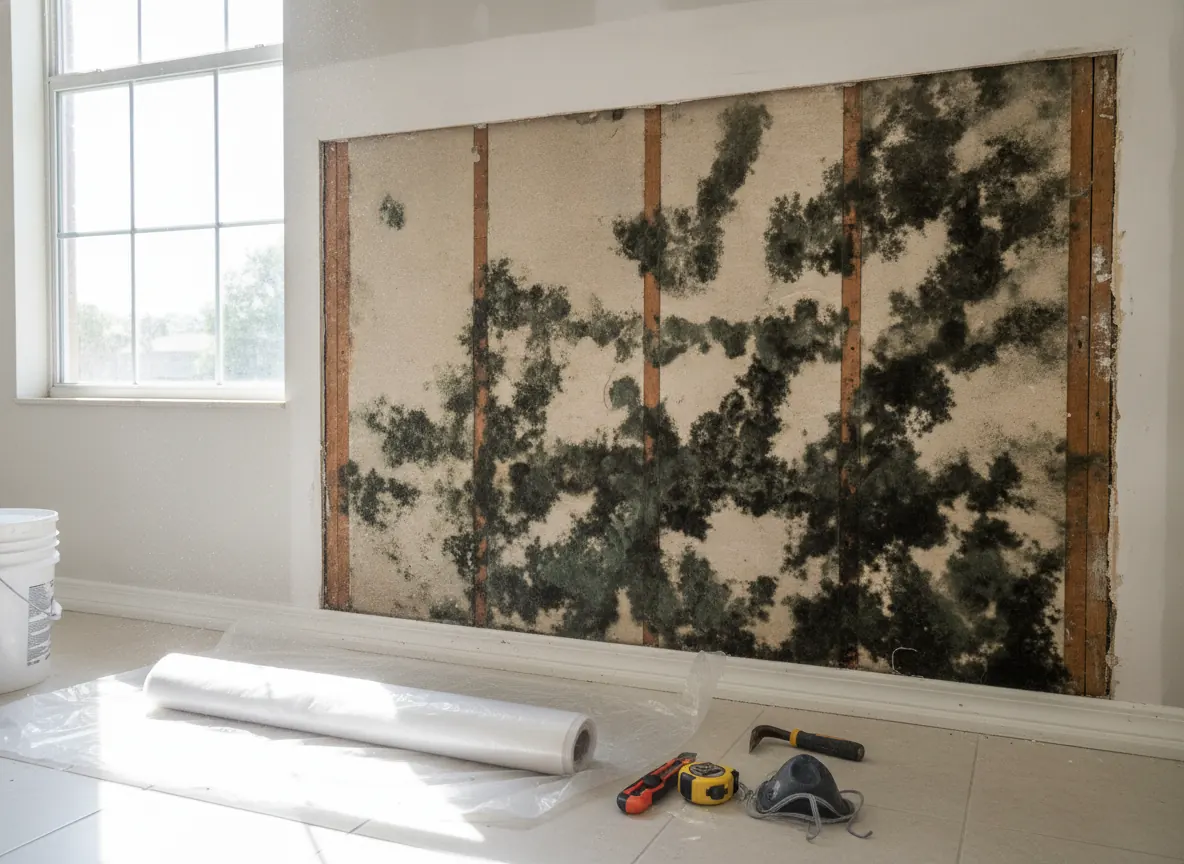
What people usually mean by "black mold"
"Black mold" is a nickname, not a diagnosis. Many molds look black, dark green or gray. People often mean Stachybotrys chartarum, a greenish-black mold that grows on materials that stay wet, like drywall paper. You can't tell which mold you have by looking at it, and you usually don't need to know.
Where dark mold shows up in Sarasota homes
- On drywall behind baseboards after a leak or flood.
- On ceilings below a roof leak or an AC drain line that backed up.
- In closets on outside walls, where air is still and humid.
What EPA and CDC say about mold color
CDC advises that it isn't necessary to find out what type of mold you have. All molds should be treated the same way when it comes to health risks and removal. EPA's approach is the same: fix the moisture, then clean or remove the moldy material.
That is also why testing is usually optional. EPA says, "In most cases, if visible mold growth is present, sampling is unnecessary." Testing helps with hidden mold, disputes, home purchases and clearance checks after the work. See mold inspection and testing for when it helps.
What matters more than color: the size of the area, what it grows on (drywall usually goes; tile can be cleaned), whether the leak is fixed, and who in the home is sensitive.
What a mold remediation company typically does
The steps are the same for any color of mold.
Find the water
Trace the leak, flood line or condensation that fed the mold, and check nearby walls with a moisture meter.
Contain the area
Seal the room or wall section with plastic sheeting and run negative air with a HEPA unit so spores and dust stay put.
Remove and clean
Cut out moldy drywall, baseboards and insulation, bag them inside the containment, and clean framing and hard surfaces.
Dry and HEPA-vacuum
Dry the framing and concrete with fans and dehumidifiers, then HEPA-vacuum and wipe the work area.
Document
Give you a written record of what was removed, with photos, so a rebuild contractor and your insurer can see it.
For the full sequence, including optional clearance testing by a separate assessor, see the process page and the main mold removal page.
Why dark mold is common in Sarasota
Mold needs moisture, and Sarasota has plenty. The Sarasota Bradenton airport averages about 49 inches of rain a year, and about 60% of it falls June through September (NOAA 1991–2020 normals). Summer dew points in the Tampa Bay area average about 72 to 74°F, so cool surfaces can collect condensation.
Recent storms added to it. Hurricane Debby dropped 16.98 inches of rain in Sarasota in August 2024, the highest total in the state. Helene's surge followed in late September, and Milton made landfall on Siesta Key on October 9, 2024. Drywall that got wet and wasn't dried can grow mold behind baseboards months later. If your mold traces back to a storm, see mold after hurricanes and floods.
What black mold removal costs
There is no separate price for black mold. Cost depends on size, location and what has to come out.
| Item | Typical range | Source |
|---|---|---|
| Mold remediation, typical job | $1,500–$9,000 (avg ≈ $3,500) · $1,200–$3,750 (avg ≈ $2,300) | Fixr, Aug 2025 · This Old House, Mar 2026 |
| Per square foot | $10–$30 · $10–$25 | Fixr, Aug 2025 · This Old House, Mar 2026 |
| Walls | $1,000–$12,000 | Fixr, Aug 2025 |
| Air test · surface (tape/swab) test | $500–$700 · $150–$200 | Fixr, Jan 2025 |
Drywall replacement and painting are often a separate rebuild bid. Compare scopes line by line with the Sarasota mold remediation cost guide.
Health note
EPA and CDC describe mold's main health effects as allergic and irritant reactions, such as a stuffy nose, itchy eyes, coughing or wheezing. People with asthma, allergies or weakened immune systems may be more sensitive. If anyone in the home has symptoms, see a doctor.
When to call a company and when to clean it yourself
Florida's mold-licensing law covers mold growth over 10 square feet (s. 468.8411). For smaller areas, EPA says you can usually clean it yourself. Homeowners may also work on their own home (s. 468.841).
For a small patch, fix the water first, wear gloves, goggles and an N95 respirator, scrub hard surfaces with detergent and water, and dry them fully. Throw out stained drywall or carpet pad.
Get quotes when the area is over about 10 square feet, it comes back after cleaning, it follows a flood, or you smell mold but can't find it. Renters should tell the landlord in writing first; see mold in rentals.
Questions to ask before you hire
Florida licenses mold assessors and mold remediators through the Department of Business and Professional Regulation (DBPR) under Chapter 468, Part XVI. Before you hire, look up the company's license at myfloridalicense.com (search by name or license number). Some contractors are exempt (s. 468.841); ask which license covers the work.
In Florida, a company that does the mold assessment generally can't also do the remediation on the same structure within 12 months, and vice versa (s. 468.8419). If you want testing, plan on two companies.
- The company's DBPR license number. Look it up at myfloridalicense.com before you sign.
- A written contract signed by both sides (s. 468.8422).
- Proof of insurance (the law requires $1,000,000 general liability, s. 468.8421).
- A written assessment or remediation plan: what will be removed, cleaned or left, and how the area is contained.
- If you want a clearance test after the work, an independent assessor from a separate company.
Black mold FAQ
Is black mold more dangerous than other mold?
Color alone does not tell you the risk. CDC advises that you don't need to identify the type of mold, and that all mold should be treated the same way for health risk and removal. Health effects depend on the person and on how much mold there is. People with asthma, allergies or weakened immune systems may be more sensitive.
Should I test black mold to find out what kind it is?
Usually not. EPA says, "In most cases, if visible mold growth is present, sampling is unnecessary." Testing can still help when mold may be hidden, in a dispute with a landlord or association, before buying a home, or to check the work afterward. In Florida, use a separate company for testing than for removal.
Can I clean black mold myself?
For a small patch, often yes. EPA says you can usually clean areas under about 10 square feet yourself, and Florida's mold-licensing law covers growth over 10 square feet. Wear gloves, eye protection and an N95 respirator, fix the water source first, and throw out porous items like stained drywall or carpet pad.
How much does black mold removal cost in Sarasota?
Black mold costs the same to remove as any other mold, since the method is the same. Published national ranges run about $10 to $30 per square foot, with typical jobs from about $1,200 to $9,000 (Fixr, Aug 2025; This Old House, Mar 2026). Sarasota-area quotes vary with size, location and materials.
Get black mold removal quotes in Sarasota
Tell us where the mold is, roughly how big the area looks, and whether there was a leak, flood or storm. Photos can come later. We pass it to independent companies serving Sarasota, Bradenton, Venice and nearby towns, and they reply with quotes.
Describe your situation any time; companies reply on their own schedules. Sarasota Mold Experts is a free quote service, not a mold company. The companies are independent and may pay to receive requests. There is no obligation, and you choose who to hire. Prefer to talk? Call (941) 393-1454
Found mold or a musty smell? Get free quotes.
Describe it once and independent mold companies serving Sarasota and Manatee counties can reply with no-obligation quotes.