
Why Is There Mold on My Bathroom Ceiling? Causes and Fixes
Small gray or black spots on a bathroom ceiling are one of the most common mold questions in any humid place, and Sarasota is very humid. Most of the time the cause is simple: warm shower air meets a cooler ceiling, water condenses, and mold grows where the paint stays damp. Sometimes, though, the spots are a sign of a leak above the ceiling. This guide helps you tell the two apart and decide what to do.
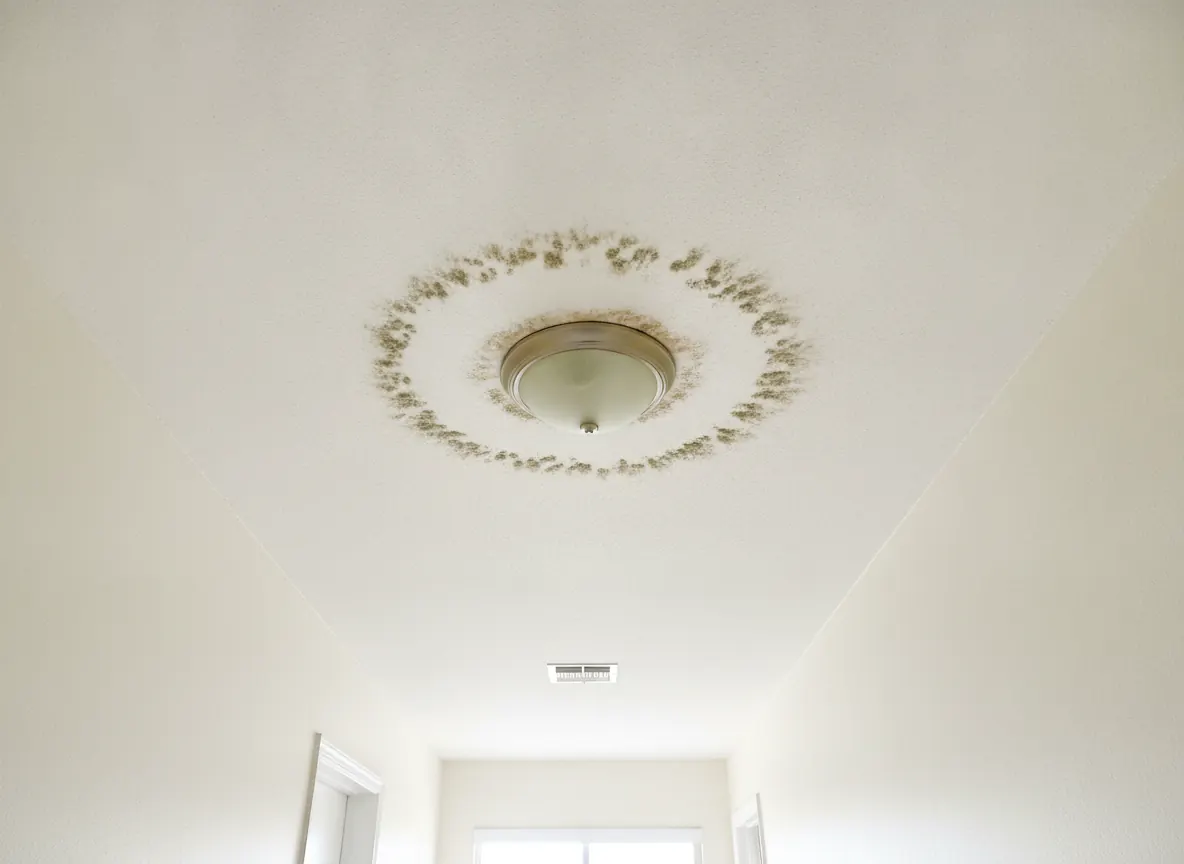
What causes mold on a bathroom ceiling?
Mold grows where moisture stays long enough. On a bathroom ceiling, that moisture usually comes from one of these:
- Shower steam with too little ventilation. No fan, a fan that is too weak, or a fan that is switched off as soon as the shower ends.
- A fan that vents into the attic. The fan moves wet air out of the bathroom and into the attic, where it can condense on roof decking and drip back onto the ceiling.
- A roof or flashing leak. Common after storms, and often shows up first as a tan or brown water stain.
- A leak from above. In a two-story home or a condo, a toilet, tub, shower pan or supply line upstairs can leak into your ceiling.
- Sweating ducts or registers. In a Florida summer, a cold AC supply register in the bathroom ceiling can collect condensation from humid air.
Is it surface mold or something more?
Surface mold from shower steam tends to look like light speckling spread over the paint, often heaviest above the shower or in corners. A problem from above tends to look different. Use the table as a rough guide, not a diagnosis.
| What you see | What it may mean |
|---|---|
| Light speckling near the shower that wipes off and returns slowly | Likely surface growth from steam; improve ventilation |
| A brown or yellow ring, with or without spots | Water has come through from above: a roof, attic, plumbing or AC source |
| Soft, bulging or sagging drywall | Wet material; mold may be on the back side or in the insulation |
| Spots that return within days of cleaning | An ongoing moisture source that cleaning doesn't fix |
| A patch growing larger than about 10 square feet | Larger than EPA's do-it-yourself size; Florida's mold license law applies to work at this size |
| A musty smell in the attic or the room below | Possible hidden growth above the ceiling |
Check the bathroom fan first
A working fan that vents outdoors solves most steam-related ceiling mold. Check it in this order:
- Turn it on and hold a single tissue near the grille. If the tissue doesn't pull toward it, the fan isn't moving much air.
- Clean the grille; dust cuts airflow.
- Run it during every shower and for a good while after, until the mirror and ceiling are dry.
- Find out where it vents. The duct should end at a roof cap or wall vent outside, not loose in the attic. If you can't safely look, a handyman, roofer or HVAC contractor can check.
Ventilation is only half the job in Sarasota. If indoor humidity stays above EPA's 60% guideline, the ceiling will keep growing spots. The post on Sarasota humidity and mold covers the AC and dehumidifier side.
When the problem is in the attic
If the stain is brown and ringed, or the spots sit near a ceiling fixture or an exterior wall, look above. In a single-story block home, the attic sits right over the bathroom. Roof leaks often show up after heavy storms, and the 2024 season brought Hurricane Debby in August and Hurricanes Helene and Milton in late September and early October. A small roof leak from that period can keep feeding mold in insulation and roof decking long after the visible stain is painted over.
Look for dark staining on the underside of the roof decking, damp or matted insulation, and a bath fan duct lying loose. The attic mold page explains what an attic job usually involves. Roof replacement generally needs a permit, so check with your city or county building department.
In a condo, the leak may start next door or upstairs
Bathroom ceiling stains in a condo often come from the unit above or from a shared pipe. In Florida, the association maintains the common elements (s. 718.113(1)). The association's insurance excludes unit finishes such as floor and wall coverings, cabinets and appliances (s. 718.111(11)(f)), and owners insure those items (s. 718.111(11)(g)). After an insurable event, the association generally repairs unless an owner's negligence caused the damage (s. 718.111(11)(j)).
Read your declaration and talk to your manager in writing. Take dated photos before anything is cleaned or opened. This is general information, not legal advice. The condo mold page and the post on who is responsible for condo mold go further.
Cleaning a small patch yourself
For a small area of surface spots, EPA says you can usually clean it yourself. EPA's guidance is to scrub mold off hard surfaces with detergent and water and dry them completely, never to mix bleach with ammonia or other cleaners, and not to paint or caulk over moldy surfaces. Absorbent materials such as ceiling tiles may need to be thrown away if they become moldy. Protect your skin, eyes and breathing while you work, and fix the moisture source, or the spots will come back.
On health, EPA and CDC say mold can cause allergic and irritant reactions in some people, and that people with asthma, allergies or weakened immune systems may be more sensitive. If you or someone in your home has symptoms, talk to a doctor.
When to call a professional
Florida's mold-licensing law covers mold growth over 10 square feet (s. 468.8411). For smaller areas, EPA says you can usually clean it yourself. Homeowners may also work on their own home (s. 468.841). Consider getting quotes when:
- The patch is larger than about 10 square feet, or spreads past the ceiling onto walls.
- The drywall is soft, sagging or stained from above.
- Spots return quickly after cleaning and a working fan.
- There is a musty smell in the attic, or you find mold on the roof decking.
- The water came from another unit or a shared pipe and you need a written record.
The mold removal page walks through what a licensed remediator typically does, from containment to drying. If you aren't sure where the moisture is coming from, the mold inspection and testing page explains when an assessment helps.
What bathroom mold remediation costs
| Item | Typical range | Source |
|---|---|---|
| Bathroom | $500–$1,500 | Fixr, Aug 2025 |
| Attic | $1,500–$9,000 · $1,000–$4,000 | Fixr, Aug 2025 · This Old House, Mar 2026 |
| Per square foot | $10–$30 · $10–$25 | Fixr, Aug 2025 · This Old House, Mar 2026 |
Ceiling repair, paint and any roof or plumbing fix are usually priced separately. The mold remediation cost page has the full table and a calculator.
Questions to ask before you hire
- What is your DBPR license number? (Check it at myfloridalicense.com.)
- Will you give me a written contract (s. 468.8422) and a written remediation plan?
- Can I see proof of insurance? Florida requires remediators to carry at least $1,000,000 in general liability coverage (s. 468.8421).
- How will you find and stop the moisture source, or who should I call for that?
- If I want a clearance test afterward, will it be done by an independent assessor?
Florida license check. Florida licenses mold assessors and mold remediators through the Department of Business and Professional Regulation (DBPR) under Chapter 468, Part XVI. Before you hire, look up the company's license at myfloridalicense.com (search by name or license number). Florida's mold-licensing law covers mold growth over 10 square feet (s. 468.8411). In Florida, a company that does the mold assessment generally can't also do the remediation on the same structure within 12 months, and vice versa (s. 468.8419).
Sarasota Mold Experts is a free quote service in Sarasota, FL, not a mold company. Describe your situation any time, and independent local companies reply on their own schedules. Some companies pay to receive requests, and none of them is affiliated with this site. Request a free quote or call (941) 393-1454.
Frequently asked questions
Why does mold keep coming back on my bathroom ceiling?
Usually because the moisture is still there. A fan that is too weak, switched off too soon or venting into the attic leaves the ceiling damp after every shower. High indoor humidity and leaks from above also feed regrowth. Fix the moisture source, then clean, and the spots should stop returning.
Can I just paint over mold on a bathroom ceiling?
No. EPA advises against painting or caulking over moldy surfaces. Paint can hide the spots for a while, but mold underneath keeps growing if the surface stays damp. Clean small areas with detergent and water, dry them fully, fix the ventilation, and then repaint with a bathroom-rated paint if you like.
Is mold on a bathroom ceiling dangerous?
EPA and CDC say mold can cause allergic and irritant reactions in some people, and people with asthma, allergies or weakened immune systems may be more sensitive. Color doesn't tell you the risk. Clean small areas promptly, get help for larger ones, and see a doctor if anyone has symptoms.
How much does bathroom mold removal cost?
Fixr's August 2025 national estimate for bathroom mold remediation is about $500 to $1,500. Jobs that reach into the attic or need drywall removed cost more, and ceiling repair is often priced separately. Sarasota-area quotes vary with the size, the cause and access, so compare written quotes.